Game Design Fundamentals
Subject: Game Design Development (VU-CSC 224)Introduction to Game
A game is more than just playing for fun; it is an organized activity with rules, goals, challenges, and interaction that keeps people engaged and entertained. From traditional African games like Ayo to modern video games such as FIFA and Minecraft, games have always been part of human life and culture. People play games to relax, compete, learn, and connect with others. A game usually requires players to make decisions and follow certain rules in order to achieve a goal, whether that goal is to win points, solve a problem, defeat an opponent, or complete a mission. The fun often comes from competition, strategy, and the excitement of not knowing what will happen next.
Games are not only for entertainment; they also help in learning and personal development. Children improve their thinking skills through puzzles, learn teamwork through sports, and develop patience and planning through board games. In schools, educational games make difficult subjects like mathematics and science easier to understand because students learn by doing rather than only reading. For example, a quiz app with levels, rewards, and points can make studying more interesting and less stressful. In professional fields, simulation games are used to train pilots, doctors, and engineers by allowing them to practice in safe environments. This proves that games are useful tools for both enjoyment and learning.
A game becomes truly interesting when there is a good balance between challenge and reward. If a game is too easy, players become bored, but if it is too difficult, they may give up. A good game keeps players motivated by setting clear goals and giving rewards for progress. Football is a simple example: the aim is to score more goals than the other team, yet the teamwork, strategy, and skill involved make it exciting all over the world. The same happens in video games, where players are driven by achievement, curiosity, and adventure. This is why game design and development is an important field today.
Game Design and Development
Game design and development is the process of creating interactive digital experiences commonly called games for entertainment, education, training, or simulation. It combines creativity, storytelling, art, programming, sound, and user experience to produce engaging gameplay.
What is Game Design?
Game design is the planning and conceptual stage of game creation. It focuses on how the game works and how players interact with it.
Game design is the creative process of planning how a game works and how players experience it. It is the stage where ideas are transformed into rules, objectives, characters, challenges, rewards, and interactions before actual programming begins. In simple terms, game design answers questions like: What is the goal of the game? Who are the players? What challenges will they face? How do they win or lose? A game designer focuses on creating an enjoyable and meaningful experience for the player, ensuring that the game is fun, balanced, and engaging.
Key elements of game design include:
1. Storyline/Narrative: the plot, characters, and setting of the game
2. Gameplay Mechanics: rules, controls, objectives, and challenges
3. Level Design: arrangement of stages, obstacles, and rewards
4. User Experience (UX): how enjoyable and intuitive the game feels
5. Game Balance: ensuring fairness and difficulty progression
A game designer decides what the player does and how the game responds.
What is Game Development?
Game development is the technical process of building the actual game using software tools and programming.
It includes:
1. Programming: writing the code that controls the game
2. Graphics Design: creating 2D/3D characters, environments, and animations
3. Sound Design: music, voice, and sound effects
4. Testing: finding and fixing bugs
5. Deployment: publishing the game for players to use
A game developer turns the design idea into a working product.
Difference Between Game Design and Game Development
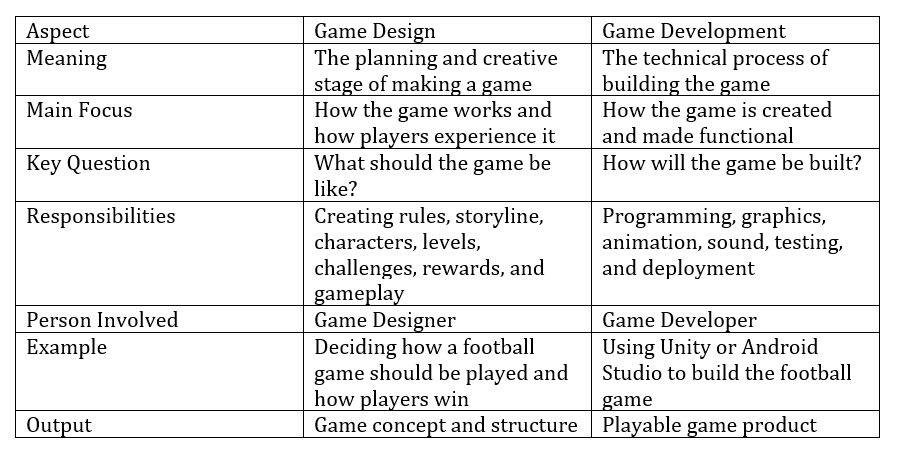
By: Vision University
Comments
No Comment yet!
Login to comment or ask question on this topic
Next Topic